
Chimney Sweeping vs. Chimney Inspection: What Is the Difference?
In a Connecticut home with one or more flues, learn what sweeping removes, what inspection checks, and how to …
Inspections & home decisions
A camera can document the inside of a tall Connecticut chimney. Learn when a flue scan helps, what it cannot see, and how to read labeled findings.
Call 475-270-6677
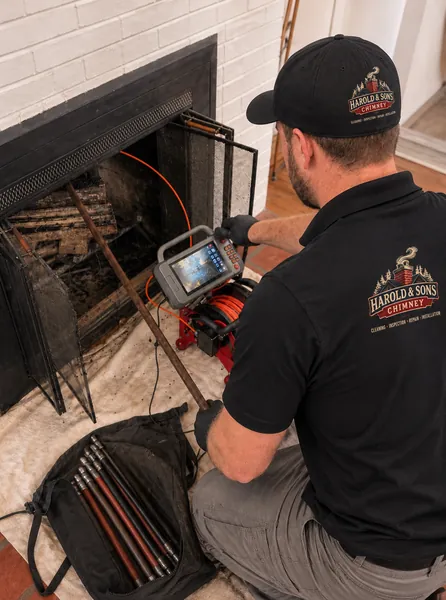
Imagine standing in front of a fireplace and trying to judge the condition of the flue from the room. You can see the opening, perhaps the damper and a little of the smoke chamber. The flue may turn, rise through several stories, or sit behind masonry that hides almost everything important. A video inspection is a way to look inside that passage. It is not an X-ray of the entire chimney, and it does not turn a still image into an automatic diagnosis.
The most useful result is a clearer record of what the technician could actually see: the surfaces of a clay liner, metal liner, or another vent component; joints or changes in material; deposits or debris; and areas that warrant closer evaluation. The question is whether that information changes a homeowner's decision. Sometimes it does. Sometimes the finding is that a camera cannot get a reliable view until the flue is cleaned or accessed differently.
A recent home purchase is one common reason. A general home inspection may note that a fireplace exists without documenting the internal surfaces of its flue. If you plan to use an older fireplace, a video chimney inspection can be part of a more complete look at what the seller or previous owner may not know. The Chimney Safety Institute of America describes examination of internal flue surfaces as part of a Level 2 inspection, commonly performed with a camera or another suitable means.
A change to the system is another reason. If a wood stove is being installed, an insert is proposed, or an appliance has been replaced, the old flue's visible condition and configuration matter. A camera may help reveal a joint, offset, damaged area, or obstruction that cannot be seen from the hearth. It does not decide whether a new liner meets the appliance manufacturer's requirements; sizing, material, and the full installation need separate evaluation.
Changes in performance also matter. Smoke entering a room, new debris in the firebox, signs of a prior chimney fire, or a repeated blockage can justify a closer internal look. A caller who says a sweep found cracked flue tiles after a chimney fire needs more than a quick photograph of one piece of tile. The scope should establish the extent of visible damage and whether additional concealed areas require a different inspection approach.
In a clay-tile-lined masonry flue, the camera may show tile faces and joints, missing pieces, cracks, or openings. In a metal-lined flue, it may show visible distortion, corrosion, separation, or debris, depending on access and visibility. The same word, “crack,” can describe very different conditions. Ask the technician to point out where in the system the image was captured and why the feature matters.
The camera can also make a blockage more understandable. Nest material, fallen masonry, or a buildup of deposits may appear in the path. Visibility can be limited if the surface is covered with soot or glaze. When the image is obscured, the honest result is “We need to clean this before we can evaluate it properly,” not a definitive opinion about the underlying liner.
A scan may help answer a homeowner's practical question: “Is the debris on my hearth coming from the flue?” It can compare the interior surfaces with the material found below. But the camera cannot always identify the age of a defect, prove that an entire flue is sound, or see into all the spaces behind the liner. Its value comes from being used with exterior, appliance, and accessible structural observations.
The chimney includes more than the passageway. A camera inside the flue does not directly inspect roof flashing, a cracked crown, water moving behind siding, a hidden combustible clearance, or the full condition of a factory-built chase. If the complaint is a ceiling stain after rain, the chimney's exterior and surrounding roof may be more important than the flue scan. Chimney leak repair starts with tracing the moisture path, not selecting the most impressive tool.
A video also needs interpretation. A still image of a dark line cannot, on its own, tell a homeowner whether a liner must be repaired, relined, or replaced. The technician should explain the location and extent of the visible condition, the type of appliance connected to the flue, and any limits on what was observed. If a proposal calls for major work, ask which images support that recommendation and what alternatives were considered.
Even the best scan cannot guarantee that every hidden part of the chimney is safe. CSIA describes Level 3 inspections for situations in which earlier inspection levels suggest a serious concealed hazard that cannot be evaluated without accessing concealed portions. That is a different scope and may involve disturbing building materials only when necessary. A routine video scan is not permission to open walls, nor a substitute for discussing why additional access may be needed.
Ask whether you will receive photos, clips, or written notes and how the technician will identify each location. “This is the upper section of the wood-fireplace flue near the crown” is more helpful than a collection of unlabeled screenshots. If a house has multiple fireplaces or a furnace and a stove in the same chimney structure, each relevant flue should be identified separately. One image should not be treated as a report for the whole house.
Useful documentation separates observation from recommendation. The first says what was visible, for example a missing section of joint material or an obstruction. The second explains the work proposed and why it follows from the observed condition. If deposits limited visibility, that limitation should be recorded. A homeowner comparing estimates can then ask a focused question instead of debating two vague conclusions.
For a real-estate transaction, timing and clarity matter. A buyer may need to understand whether the fireplace can be evaluated before closing and what questions to take back to the seller. A seller may have a general inspection note that says “chimney evaluation recommended” without describing the concern. Ask what a specialist can evaluate within the available access and whether a written home-sale chimney inspection is included.
Tell the company which appliance the flue serves, whether the system has been used recently, and when it was last professionally inspected or cleaned. Share any prior inspection reports or photographs of fallen debris. If you know the brand of an insert or stove, keep the manual or model information available. These details help frame the scan and any compatibility questions.
Clear a safe working area near the hearth, and do not light the appliance immediately before the scheduled visit unless instructed. You do not need to scrape deposits yourself or climb onto the roof to take pictures. If a carbon monoxide alarm has sounded or smoke is entering occupied rooms, stop using the appliance and follow emergency guidance; a future camera appointment is not the immediate response to a current hazard.
If the house has more than one fireplace, request a labeled image sequence for each inspected route. A close-up of a cracked tile means little if nobody can tell whether it belongs to the living room fireplace or the furnace flue. Ask the technician to identify the point where the camera entered, the direction of travel, and any area the camera could not reach. That record helps a second professional review a proposed repair without guessing at the location. If deposits obscure a section, the report should say whether cleaning and a return look would change the conclusion. A camera is valuable because it makes hidden conditions discussable; labeling and context turn footage into usable evidence.
In a two- or three-story house in Hartford or New Haven, a flue may pass through several levels before it reaches the roof. A camera introduced from an appropriate access point can help document the interior route and the position of a defect without asking the homeowner to look down from a high rooftop. It does not eliminate the need to examine the chimney top, roof junction, or exterior masonry when those areas are part of the concern. Ask the inspector to label distance and direction in the footage and identify which fireplace or appliance connects to the flue shown. If a high or steep roof limits exterior access on the day, the report should state that limit and how the missing view will be obtained.
Will a camera find every crack? It can reveal visible conditions on surfaces it can reach and see. Deposits, turns, obstructions, or hidden construction can limit the view. Ask what was visible and what remains uncertain.
Is a video inspection the same as a Level 2 inspection? A video scan is a tool often used within Level 2. The inspection level also defines other areas and components to examine. Confirm the full scope rather than assuming the camera alone completes it.
Should the flue be swept first? That depends on deposits and the reason for the visit. Heavy buildup may block a useful view. A technician should explain whether cleaning is needed and whether it is included in the appointment.
Can a video tell me whether I need a new liner? It may show evidence relevant to that decision. Appliance type, liner material, dimensions, condition, and installation details also matter. Ask for a written reason for a relining recommendation.
Will I get a copy of the footage? Ask before booking. A few labeled still images and a clear written explanation may be more useful than an unannotated video, but the report format should fit your need, especially during a home sale.
Harold & Sons Chimney works from New Haven throughout the Stamford-to-Hartford area. If you need to understand an older flue, fallen debris, a prior inspection finding, or a fireplace you have not used, tell us what you know so far. Call 475-270-6677 or use the form below to discuss the appropriate chimney inspection.
If this sounds like your situation, these pages explain the work involved.
Keep reading
In a Connecticut home with one or more flues, learn what sweeping removes, what inspection checks, and how to …

Bought a Connecticut home with an unknown fireplace history? Map every flue, gather service records, and learn…

Selling a Connecticut home after the inspector flags the chimney? Document each flue, roof-access limits, repa…
Chimney season is here
Tell us what you’ve seen — a stain, a smell, smoke in the room, or just a flue that hasn’t been checked in years. We start with the problem, not a sales pitch.
475-270-6677